Do not hesitate to give us a call or WhatsApp.
+20-155-1580-786
info@egyptbestvacations.com
Most Egypt Christmas itineraries treat the season as decoration. This one goes to the place where Christianity in Africa actually began.
Alexandria is where the Egyptian church was founded. Tradition holds that St Mark the Evangelist brought Christianity there in the middle of the first century AD and was martyred in the city, and the Coptic Orthodox Pope still carries the title Pope of Alexandria today. Egypt’s Christians have been worshipping continuously since long before most of Europe converted. Standing in Alexandria in late December, with the Coptic Nativity fast running and churches preparing for their own Christmas on 7 January, is a different experience from standing there in June.
The rest of this Cairo and Alexandria Christmas tour is the classic short introduction to Egypt, done privately. The Giza plateau and the Grand Egyptian Museum on day two. Alexandria’s Roman catacombs, Pompey’s Pillar and the Bibliotheca Alexandrina on day three. Coptic Cairo, Salah al-Din’s Citadel and Khan el-Khalili on the last morning. Four days, three nights, your own Egyptologist for all of it.
A word of honesty about the festivity itself. Egypt does not transform for 25 December the way a European capital does. You will find trees and lights in hotel lobbies and shopping centres, and real celebration in the Christian quarters of both cities, but the country as a whole carries on. What you get instead is the Giza plateau at around 19°C in low winter light, a Mediterranean corniche in Alexandria that is at its best out of season, and a Christmas Eve gala dinner at your hotel that is included in the price rather than charged as a supplement.
Choose Gold accommodation (Egyptian 5-star standard, roughly a 3.5-star in the US or Europe) or Platinum (Egyptian 5-star deluxe, roughly a 4-star). Twin, single and triple rooms are all available.
Your Egypt Best Vacations representative meets you inside the arrivals terminal at Cairo International Airport, holding a signboard, and stays with you through passport control and visa formalities. A private transfer takes you to your hotel, and the rest of the day is yours.
If you land on 24 December, tonight is the gala dinner. If not, it falls on whichever day of your itinerary Christmas Eve lands — your guide will confirm it with you on day one.
Meals Plan: No Meals Included
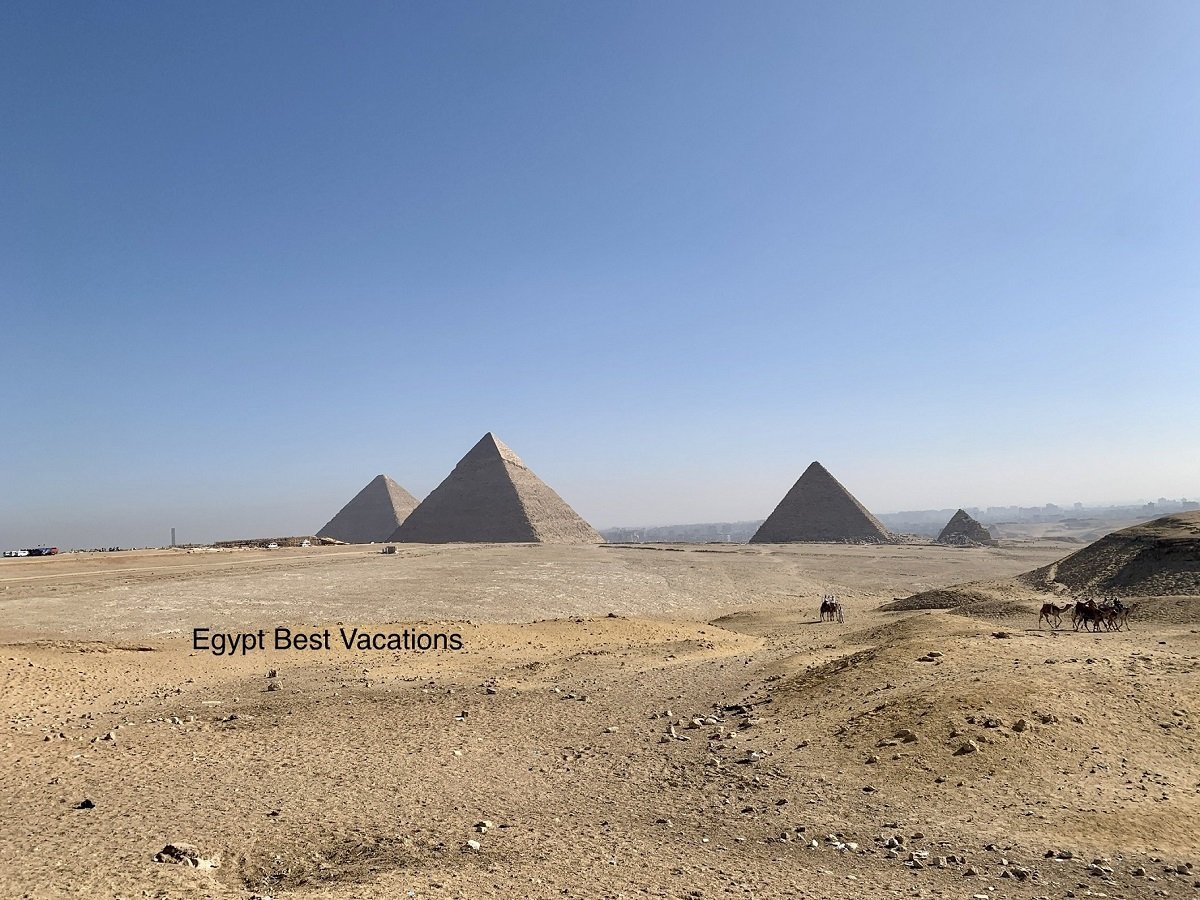
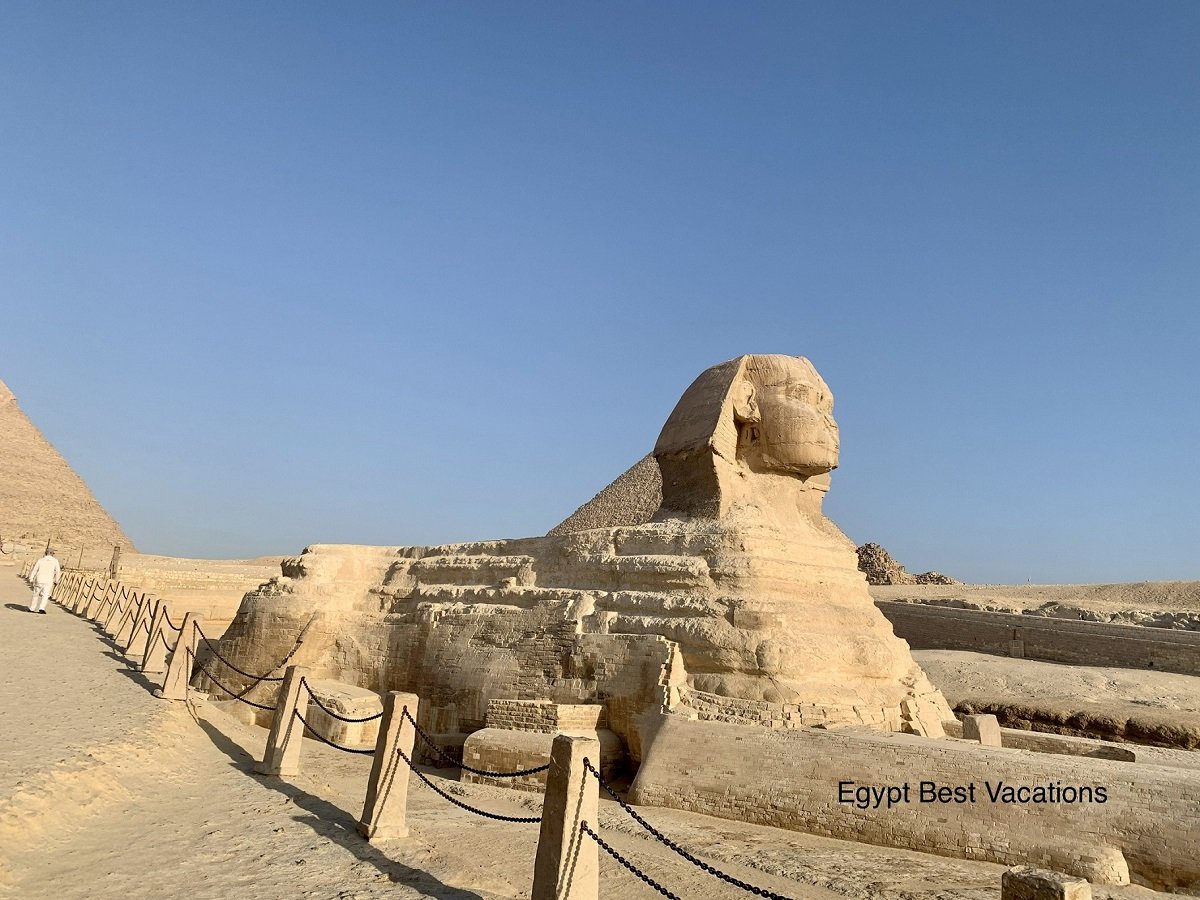
An early start for the Giza plateau, which is the right call in any season and especially in December, when the light is low and the afternoon crowds build. The pyramids of Khufu, Khafre and Menkaure went up within about eighty years of each other in the Fourth Dynasty, and Khufu’s is the last of the seven wonders of the ancient world still standing. Your Egyptologist will show you where the original casing survives near Khafre’s apex, why the three differ in size, and what the boat pits and subsidiary pyramids were for. Then down to the Sphinx, cut from a single outcrop of bedrock left behind when Khufu’s builders quarried the plateau.
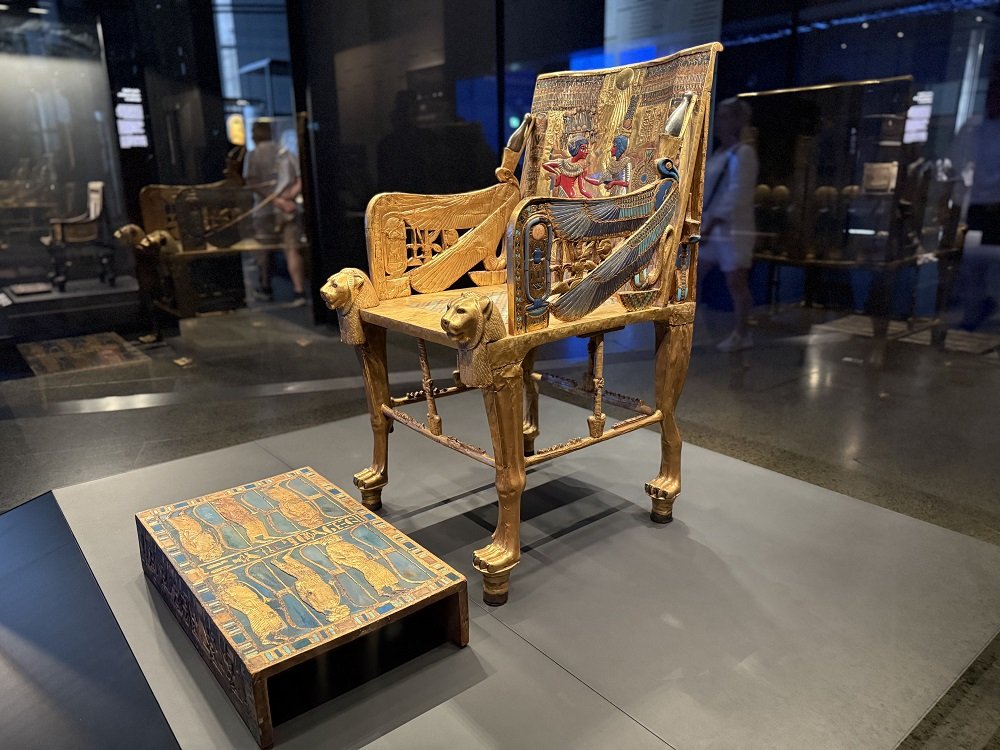
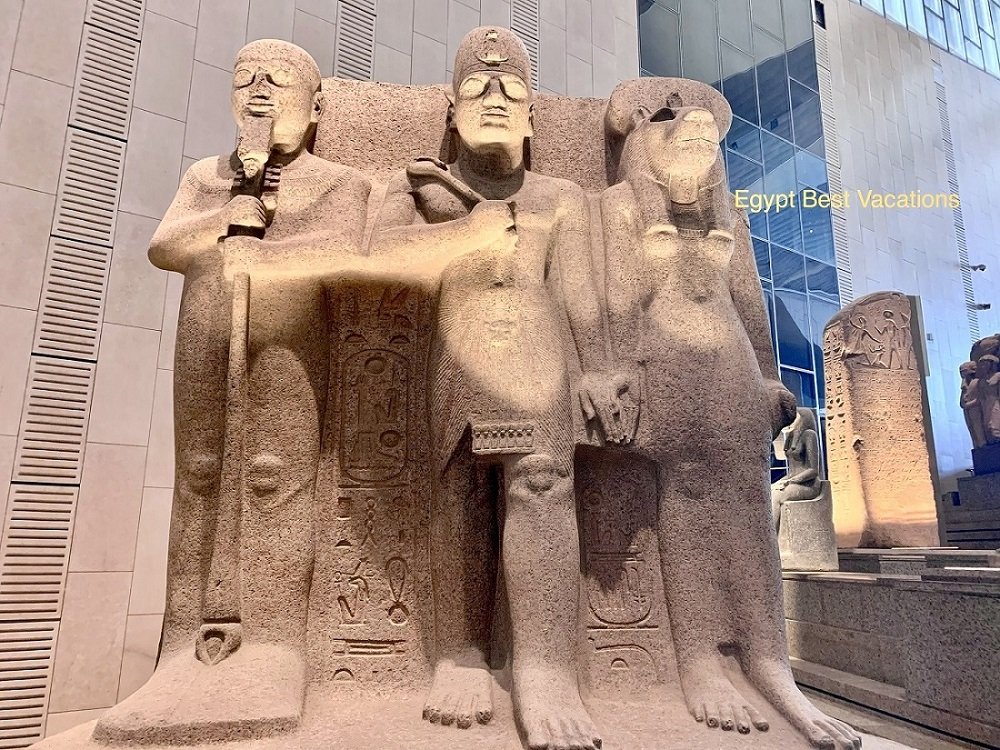
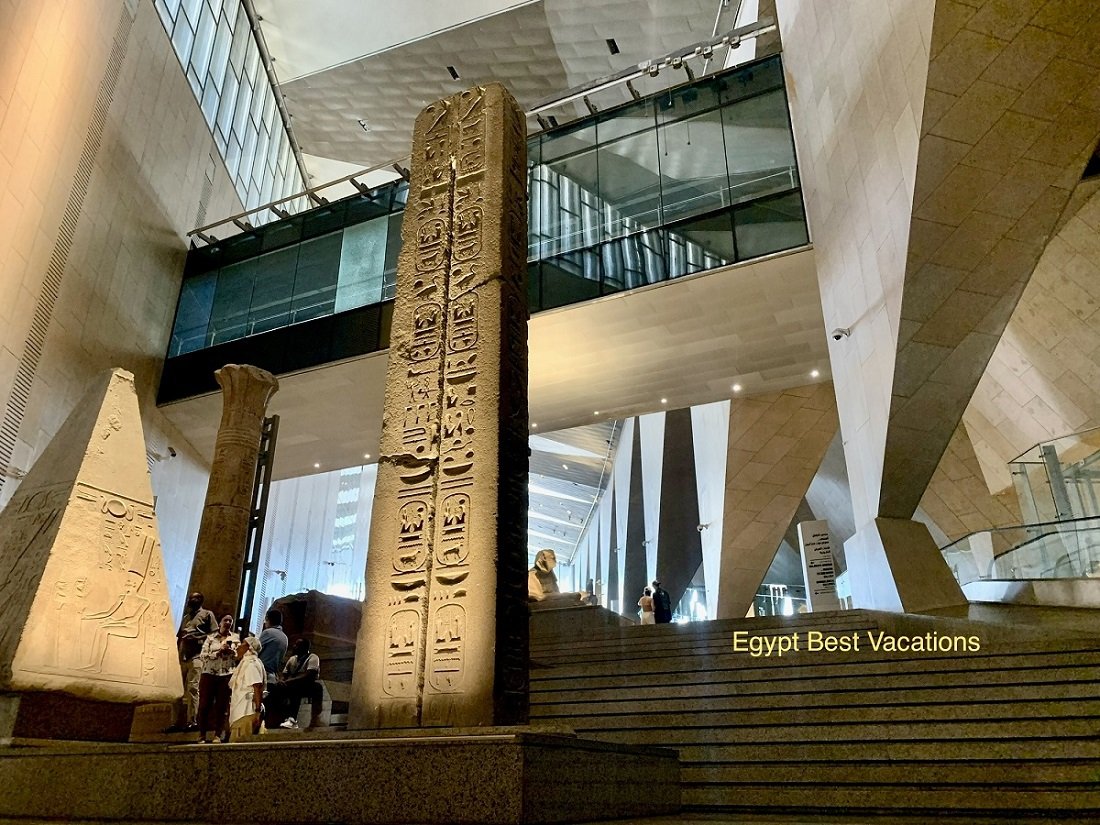
Lunch, then the Grand Egyptian Museum, two kilometres away with the pyramids framed in its glazed north wall. The complete Tutankhamun collection is here — over five thousand objects displayed together for the first time since Howard Carter cleared the tomb — along with the colossus of Ramesses II in the atrium, the Grand Staircase of royal statuary, and Khufu’s cedar solar boat.
Pyramids in the morning, what came out of them in the afternoon. Back to your hotel in the late afternoon.
Optional: Going inside the Great Pyramid
Meals Plan: Breakfast & Lunch
A long day, and worth saying so plainly: Alexandria is about two and a half to three hours from Cairo each way along the desert road, so this is an early departure and a late return. Your private vehicle makes it considerably easier than the coach alternative.
Alexander founded the city in 331 BC and it became the intellectual capital of the Mediterranean world. Start underground at the Catacombs of Kom el-Shoqafa, cut three levels into the rock in the second century AD and lost until a donkey fell through the roof in 1900. What makes them extraordinary is the collision of styles in a single chamber: Egyptian gods carved in Roman dress, Greek architectural detail, a banqueting hall where families ate beside their dead.
Then Pompey’s Pillar, which has nothing whatever to do with Pompey — that was a medieval misidentification by Crusaders. The column is a single shaft of Aswan granite close to twenty-seven metres tall, raised around 298 AD in honour of the emperor Diocletian, and it stands in the ruins of the Serapeum, the temple of Serapis that once held a daughter library of the great one.
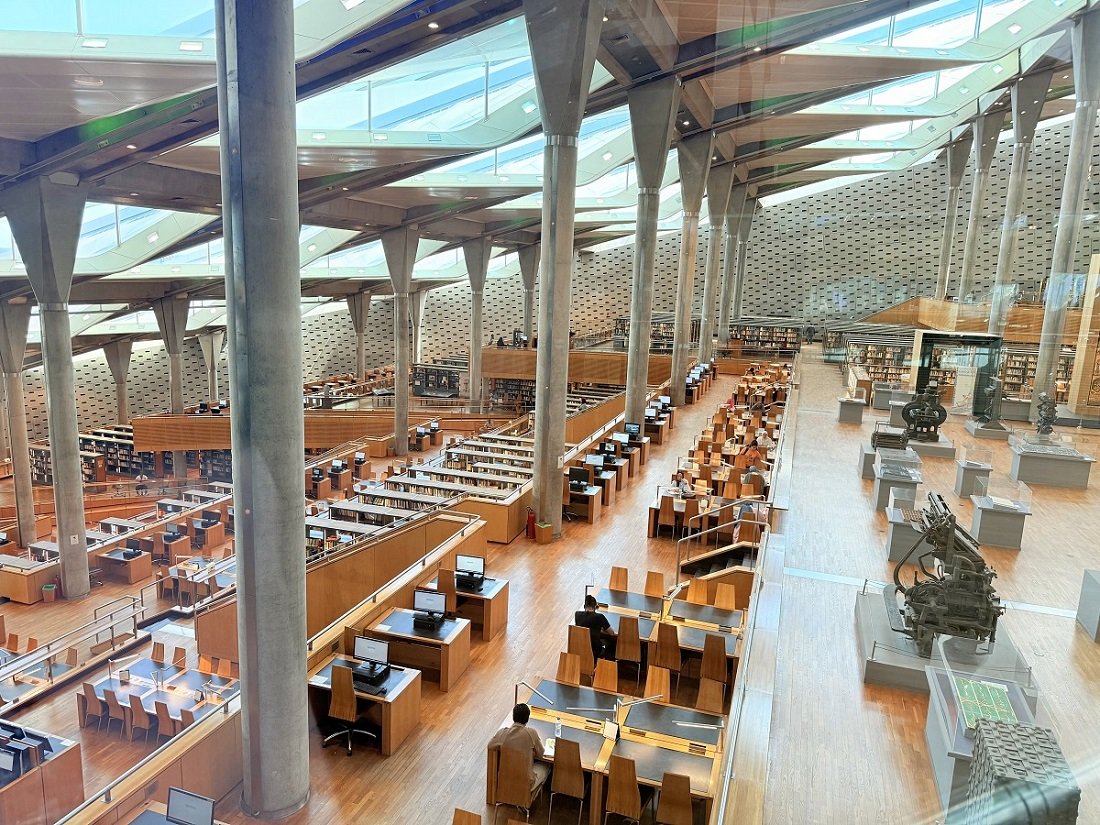
Then, to the Bibliotheca Alexandrina, opened in 2002 beside the site of its ancient predecessor. The reading room descends in eleven terraces under a tilted disc of a roof, and the complex holds manuscript and antiquities museums alongside the working library. Finally ascend the Qaitbay Fort, built on top of the destroyed Alexandria Lighthouse to defend Egypt against the Turks.
Lunch by the Mediterranean before the drive back to Cairo.
Meals Plan: Breakfast & Lunch
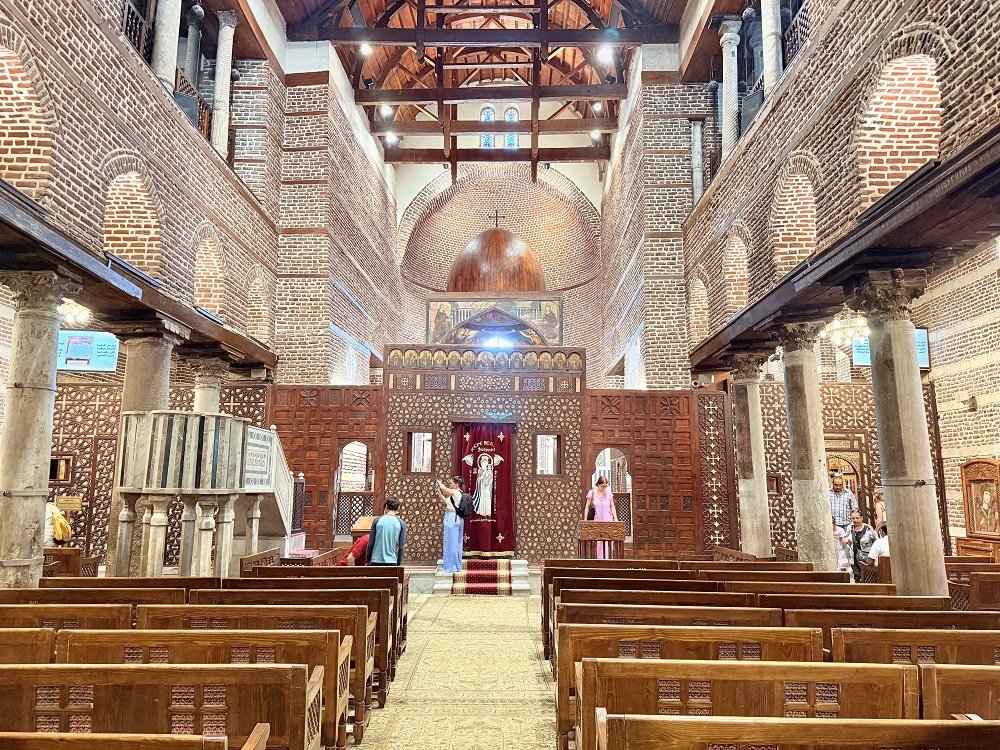
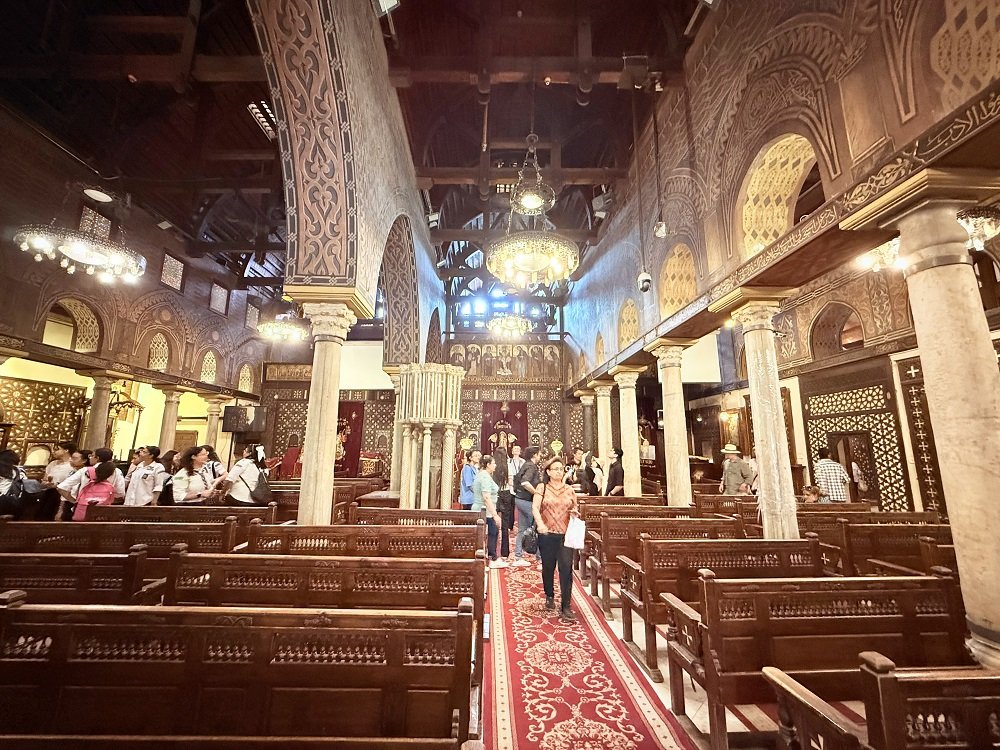
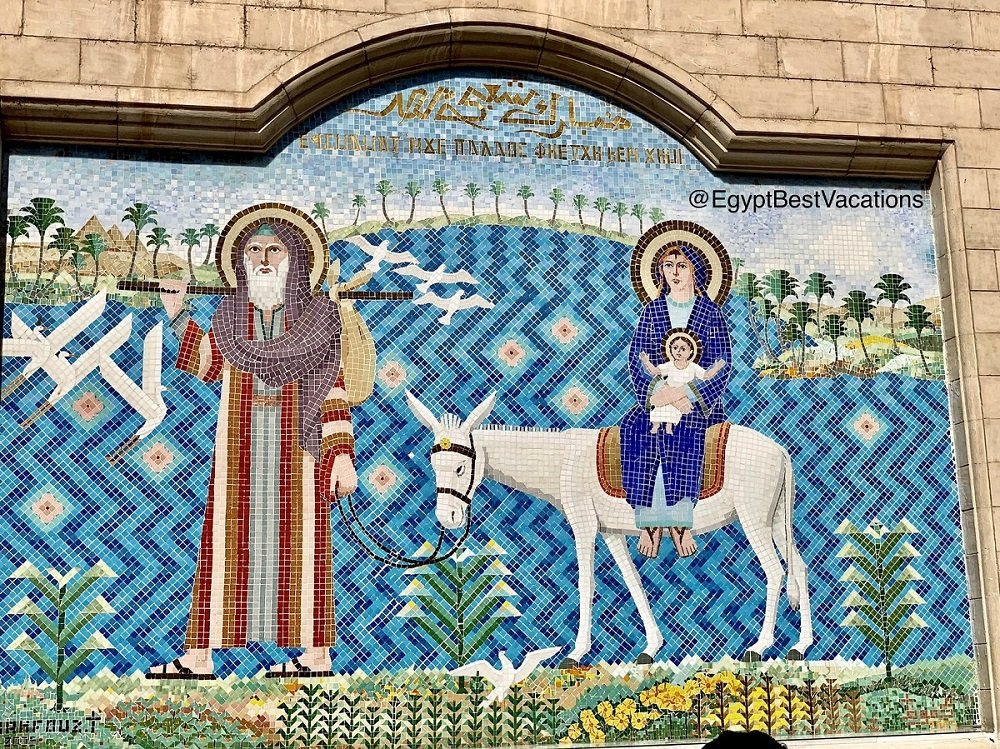
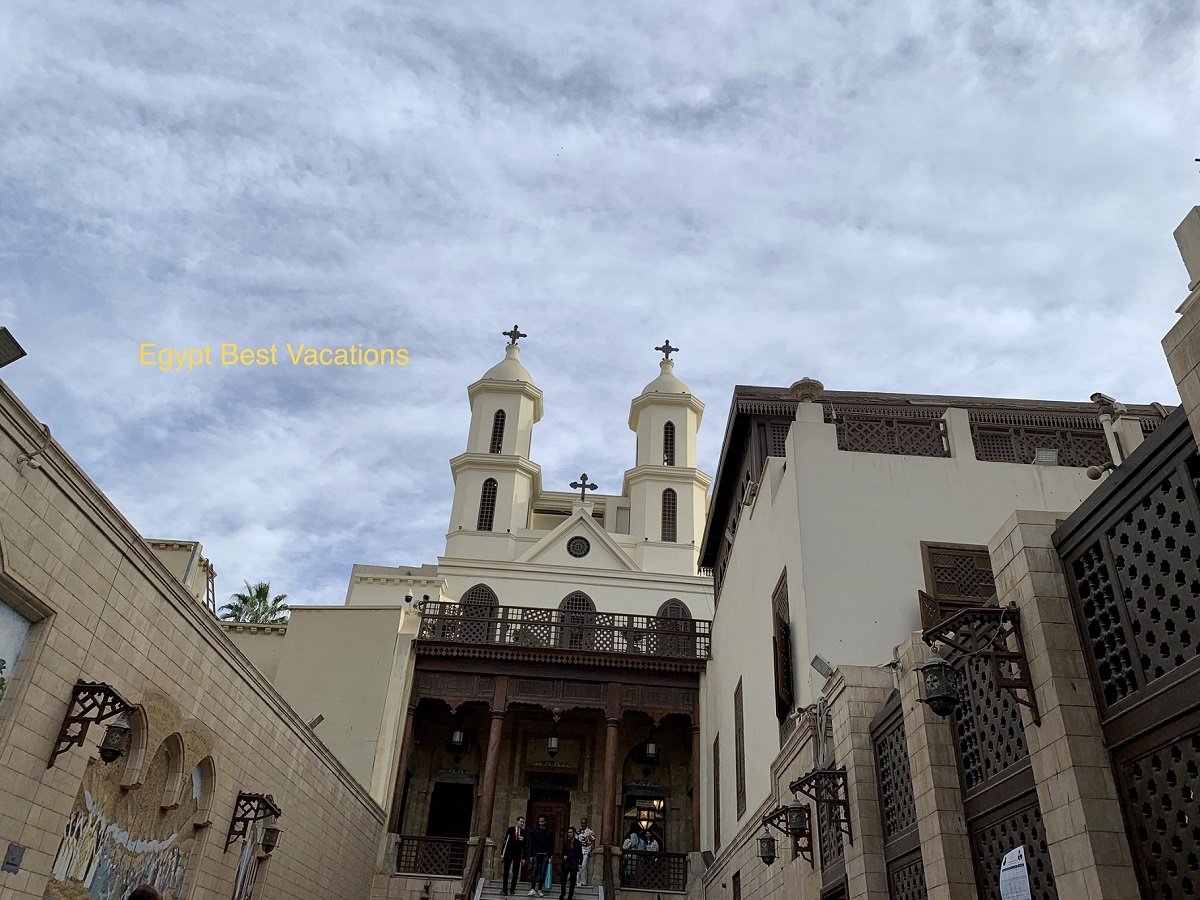
Check out after breakfast — your luggage travels with you today — and begin in Coptic Cairo, inside the walls of the Roman fortress of Babylon. The Hanging Church was founded in the third century and rebuilt from the seventh, and it is suspended over the fortress gatehouse, hence the name and hence the glass floor panel that lets you look down through it. Abu Serga stands above the crypt where tradition places the Holy Family’s refuge during the flight into Egypt. The Ben Ezra Synagogue, a few steps away, is where the Cairo Geniza was found in the 1890s — nearly three hundred thousand medieval manuscripts that rewrote what historians knew about Mediterranean trade and daily life.
On to the Citadel, begun by Salah al-Din in 1176 to hold Cairo against the Crusaders and used as the seat of Egyptian government for the following seven hundred years. Inside its walls stands the Mosque of Muhammad Ali, known as the Alabaster Mosque for the facing on its lower walls — Ottoman in plan, nineteenth century in date, and visible from most of the city.
Lunch, then Khan el-Khalili, a working bazaar since the fourteenth century and busiest in December. Your transfer to Cairo Airport follows.
If your dates run to 6 January, your guide can arrange for you to attend Coptic Christmas Eve mass. Say so at booking, because it needs planning.
Meals Plan: Breakfast & Lunch
All prices are in US dollars, per person, per trip. This tour runs on festive departures only, 21 December to 10 January, so there is a single price band rather than a seasonal ladder.
Hotels: Safir Cairo, Sonesta Hotel, Ramses Hilton, Cairo Pyramid, HolidayInn Citystars and more
| Triple room, per person | $800 |
| Twin room, per person | $900 |
| Single room, per person | $1,530 |
Hotels: Concorde El-Salam, Hilton Nile Tower, Hilton Heliopolis, Tolip Family Park and more.
| Triple room, per person | $890 |
| Twin room, per person | $1,050 |
| Single room, per person | $1,785 |
Both tiers include the Christmas Eve gala dinner, the same private Egyptologist and the same itinerary. Only the hotel changes.
All prices are in US dollars, per person, per trip. See the price table above for Gold and Platinum in twin, single and triple occupancy.
Gold — Cairo hotels licensed 5-star standard in Egypt, approximately 3.5-star by US and European standards.
Platinum — Cairo hotels licensed 5-star deluxe in Egypt, approximately 4-star by US and European standards.
We publish both the Egyptian licence category and the honest Western equivalent, because Egyptian hotel licensing is more generous than the rating you are used to at home. Both tiers use the same private Egyptologist, the same itinerary and the same gala dinner.
Twin, single and triple rooms are all available. A triple is normally a twin room with a third bed added — comfortable for three, but not spacious. Single occupancy carries a supplement.
Payment can be made online through a secure gateway with no surcharge. We accept USD, EUR, GBP, CAD, AUD and NZD.
Tipping is not included in our tour packages and is left entirely to your discretion. While it is not mandatory, it is greatly appreciated by the people who assist you during your journey.
Here is a suggested tipping list:
Driver – full day $3-5 per person per day.
Driver – transfer $1-3 per person per day.
Tour guide – full day $15-20 per person per day.
Tour guide – half day $10-15 per person per day.
Representative / tour leader $3-5 per person per day.
We do not charge cancellation fees for tours canceled due to ‘force majeure’ events such as natural disasters or other uncontrollable circumstances. However, if you cancel for personal or business reasons after we have incurred booking costs on your behalf, these costs will be charged to you.
A deposit between 25-50% is required to secure your booking through a payment link. The remaining balance will also be paid through payment links.
We don’t provide a travel insurance. We recommend to buy it beforehand if you want.
Our tours do not include entrance fees for special archaeological sites such as:
These attractions require an additional fee. Please contact us if you would like to add or adjust anything in your itinerary.
Other personal expenses during your trip may include:
Twice, and this catches people out.
25 December is marked by Egypt’s Catholic and Protestant communities, by the international hotels, and by the malls and restaurants. For most Egyptians it is a normal working day.
7 January is Coptic Orthodox Christmas, and it is the one that matters here. It is a national public holiday, and it follows a forty-three day Nativity fast running through most of what Europeans think of as the Christmas season. The main service is Christmas Eve mass on the night of 6 January.
Whichever dates you travel, you get the Christmas Eve gala dinner at your hotel on 24 December, and if you are still in Egypt on 6 January your guide can arrange for you to attend Coptic Christmas Eve mass.
Because it is where Egyptian Christianity began.
Tradition holds that St Mark the Evangelist brought Christianity to Alexandria in the middle of the first century AD and was martyred there. The Coptic Orthodox Pope still carries the title Pope of Alexandria, and the Greek Orthodox Patriarch of Alexandria does too. Egypt’s church is one of the oldest continuous Christian communities anywhere, and Alexandria is its point of origin.
Visiting in the last week of December means the Nativity fast is running and the churches are preparing for their own Christmas. St Mark’s Coptic Orthodox Cathedral, built on the traditional site of the martyrdom, can be added to your Alexandria day on request.
It is a connection almost no operator makes, and it is the reason this itinerary exists rather than a Cairo-only one.
Yes, and it is never charged as a supplement.
The gala dinner at your hotel on 24 December sits inside the tour price on every Egypt Best Vacations festive package, this one included. If another operator quotes you a cheaper festive rate, check whether the gala is in it — in Egypt it very often is not, and it is a substantial add-on when billed separately.
It falls on 24 December whichever day of your four that happens to be, and your guide confirms the arrangement with you on day one.
More muted than most brochures suggest, and worth knowing before you book.
Egypt is a majority-Muslim country and it does not transform for 25 December the way a European capital does. What you will find: trees and decorations in the hotels, lights and displays through the shopping centres, and genuine celebration in the Christian quarters — Coptic Cairo, and the churches of Alexandria where the community is long established.
What you will not find: street markets, carol singing, or a country-wide transformation.
What you get instead is the trade most people are actually making. The Giza plateau at around 19°C in low winter light without the heat or the peak-season crush, an Alexandrian corniche that is at its best out of season, and a proper gala dinner at the end of it.
Private. Your own Egyptologist, your own driver, your own air-conditioned vehicle, for all four days.
Every Egypt Best Vacations tour under seven days runs privately as standard. There is no group version of this itinerary and no supplement to pay for the private one.
It matters most on day three. Alexandria is a two-and-a-half to three-hour drive each way, and doing that on a coach to somebody else’s schedule is a materially worse day than doing it in your own vehicle, leaving when you choose.
Two and a half to three hours each way on the desert road, so day three is an early start and a late finish.
Whether it is worth it depends on what you want. If your priority is seeing the maximum number of pharaonic sites in four days, Alexandria is not the efficient choice — it is a Greek and Roman city, and its Egyptian layer is mostly underneath the modern one.
If you want the other Egypt — the Mediterranean one, Alexander’s foundation, the intellectual capital of the ancient world, and the birthplace of the Egyptian church — then it is the whole point of this itinerary, and December is a good month to be on that coast.
We would rather you knew the drive length now than discovered it at 7am on day three.
You choose between two tiers, both in Cairo, both bed and breakfast for three nights.
Gold hotels hold an Egyptian 5-star standard licence, roughly a 3.5-star in the US or Europe. Platinum hotels hold an Egyptian 5-star deluxe licence, roughly a 4-star.
We publish both figures deliberately. Egyptian hotel licensing is more generous than the system you know at home, and a hotel sold to you as “5-star” in Egypt will not always feel like one at check-in. Naming the honest Western equivalent is how we avoid that conversation happening in the lobby.
Both tiers get the same private Egyptologist, the same itinerary and the same gala dinner.
Yes. Twin, single and triple are all available on this tour.
Triples suit families and groups of three travelling together and work out cheaper per person than taking two rooms. A triple in an Egyptian hotel is normally a twin with a third bed added — comfortable for three adults but not spacious, so tell us the ages of anyone travelling and we will advise.
Single occupancy carries a supplement.
Yes, and it is one of the better reasons to be here at this time of year.
For 25 December, the international churches and larger hotels in Cairo hold services in English, and Alexandria has long-established Coptic, Greek Orthodox and Catholic congregations. Your guide can point you to the nearest.
For Coptic Christmas Eve on 6 January, the main Cairo service is at St Mark’s Cathedral in Abbassia. It is long, it is crowded, and it is genuinely extraordinary. If your dates include it, tell us at booking rather than on the day.
The churches you visit in Coptic Cairo on day four are working churches, so there may be a service in progress when you arrive. Your guide will advise on what is appropriate.
Mild days, cold nights, and almost certainly dry.
Late December daytime highs in Cairo usually sit around 19 to 20°C — shirtsleeve weather on the Giza plateau and one of the best months of the year to stand on it. Overnight it drops to about 9 or 10°C and feels colder in the wind.
Alexandria runs a degree or two cooler than Cairo and considerably windier, being on the Mediterranean. It is also the one part of Egypt that gets meaningful winter rain, so take a light waterproof for day three.
Bring layers. People consistently under pack for the evenings.
Most nationalities do. A tourist visa on arrival costs $30, is issued at the airport for a 30-day stay, and your representative helps you with it in the arrivals hall on day one.
You can also apply in advance through the official Egyptian e-Visa portal if you would rather have it settled before you fly.
Your passport must be valid for at least six months from your arrival date. Requirements vary by nationality, so check against your own passport before you travel.
Layers, and more than you expect for the evenings.
For the sites: comfortable walking shoes for sand and broken stone, sunglasses, sunscreen — the winter sun on the Giza plateau still burns — and a light jacket or fleece. Add a light waterproof for Alexandria.
For the churches and the mosque at the Citadel: clothing covering shoulders and knees, and a scarf for women to cover their hair inside the mosque. Shoes come off at the mosque door.
Also useful: a torch if you plan to go inside a pyramid, a universal adapter (Egypt runs 220V on type C and F plugs), medication in its original packaging, and small notes in Egyptian pounds for tips and the bazaar.
WhatsApp us