Do not hesitate to give us a call or WhatsApp.
+20-155-1580-786
info@egyptbestvacations.com
On Monday 2 August 2027 the Moon covers the Sun completely over Luxor for six minutes and twenty-three seconds — the longest totality anywhere on easily reached land until the year 2114. Our 2027 Luxor solar eclipse day tour watches it from inside Karnak.
That choice is not decoration. Karnak’s great precinct was built for Amun-Re, and the sun’s daily journey was the organising idea behind everything practised here for two thousand years: Ra crossing the sky in his barque, dying at the western horizon, fought through the night, reborn at dawn. The priests who served in this temple had no explanation for darkness at midday. Standing where they stood while it happens is a different thing from standing in a field, and it is the whole reason this tour exists.
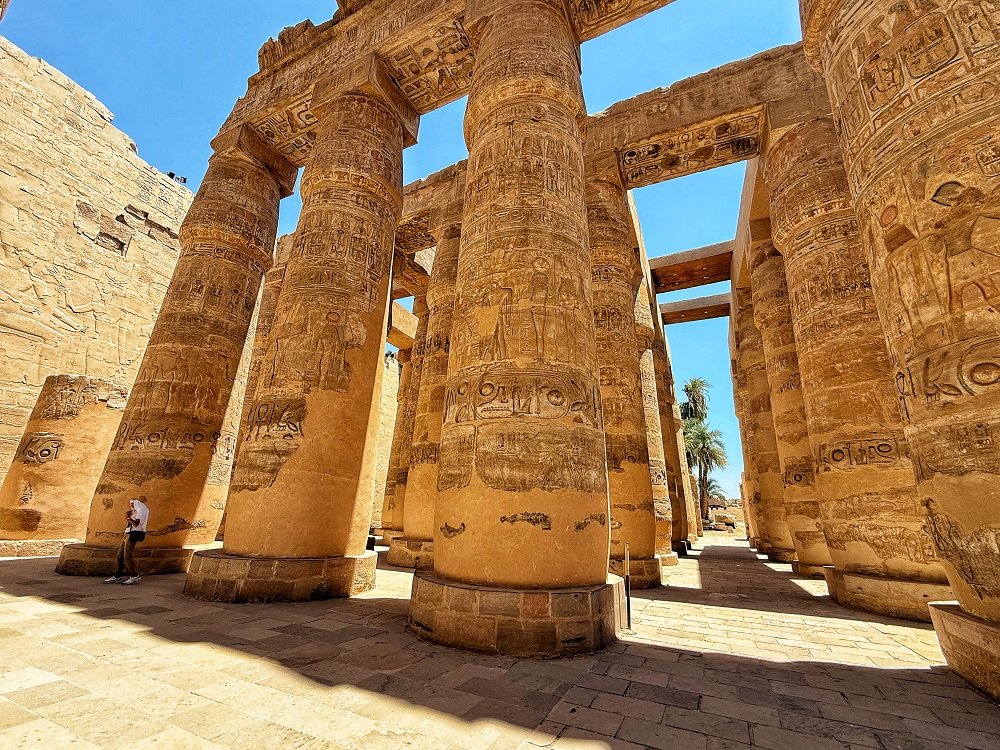
The day starts early, before the heat. You get two hours inside the temple with a qualified Egyptologist while the light is still low — the Hypostyle Hall and its 134 columns, the standing obelisks of Hatshepsut and Thutmose I, the Sacred Lake. Then a shaded break, and a briefing that covers both halves of the day: how to watch safely, and what the ancient Egyptians believed was happening. By eleven you are in position, and you do not move again until it is finished.
Then the light drains, the shadows sharpen, the temperature falls and the birds go quiet. At 13:02 the last bead of sunlight goes, the glasses come off, and the corona appears. For six minutes and twenty-three seconds you look straight at it with your own eyes, while the horizon turns sunset-coloured in every direction at once and Venus and Mercury come out at one in the afternoon.
One honest warning: this is Luxor in August, and it will pass 40°C. We build the day around that — an early temple visit — but it is a hot day outdoors and you should book it knowing so.
Small group, maximum 25 people. Eclipse day is not available as a private tour.
| Date | Monday 2 August 2027 |
|---|---|
| First contact | 11:40 local (EEST, UTC+3) |
| Totality begins | 13:02:14 |
| Maximum eclipse | 13:05:26 — Sun 82° above the horizon |
| Totality ends | 13:08:36 |
| Duration of totality | 6 minutes 23 seconds |
| Last contact | approximately 14:30 |
| Tour duration | 8½ hours east bank, 9½ hours west bank |
| Group size | Maximum 25 — small group only, not available privately |
West bank guests go first — the bridge crossing sits some seven kilometres south of the centre and adds the better part of an hour to the run. Your guide travels with the vehicle and checks the group in at each stop.
Collection from Luxor east bank hotels and from Nile cruise ships moored along the Corniche. Take breakfast at your hotel before you are collected — the tour does not stop for a meal until mid-morning, and you want food in you before the heat builds.
Vehicles meet at the coach park. Tickets are already held by your guide, so there is no queue at the gate.
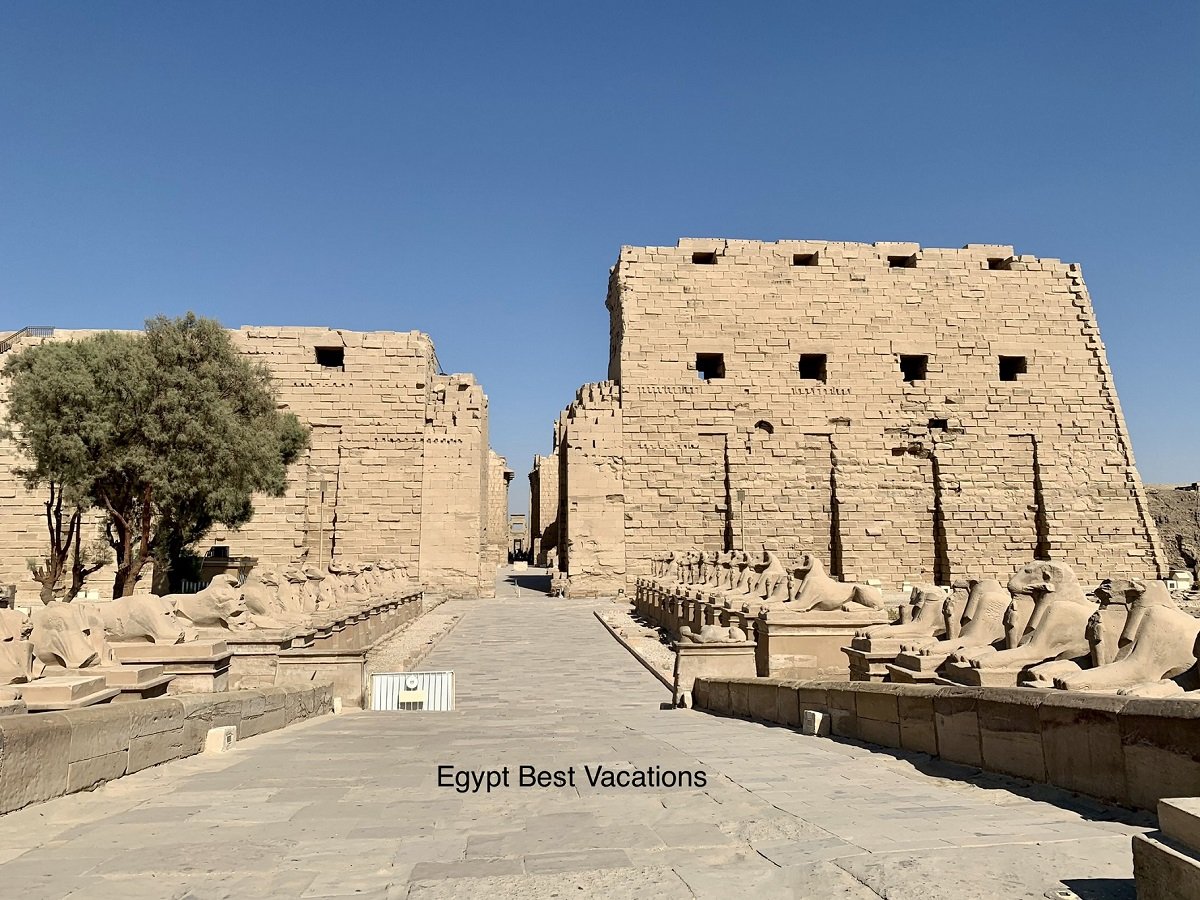
Two hours with your Egyptologist, in the best light and the coolest air you will get today. The Avenue of Sphinxes and the First Pylon; the Great Court; the Hypostyle Hall and its 134 columns; the standing obelisk of Hatshepsut and that of Thutmose I; the Festival Hall of Thutmose III; and the Sacred Lake. Roughly 100 hectares of temple, built and rebuilt across some two thousand years.
Out of the sun, buy yourself a cold water, soft drinks, tea and coffee, and a light snack. From here the day stops being about sightseeing and starts being about staying cool and hydrated — Luxor will already be in the high thirties, and it climbs from now on.
Forty-five minutes, seated in shade. Your guide covers two things. Safety first: how to use certified glasses, the exact moments they come off and go back on, and the rule that they are never used with a camera, binoculars or a telescope. Glasses are handed out here and checked individually for scratches and tears. Then context — Ra’s solar barque, the temple’s own solar alignment, and what the priests of Amun-Re would have made of the sun going out above their sanctuary.
We settle into the open ground by the Sacred Lake precinct, with shade cover, seating and water. This is the last movement of the day. Nobody walks between the monuments once first contact begins, and there is no returning to the hotel in between — expect the roads around Karnak to be closed or gridlocked from late morning.
The Moon touches the Sun’s edge. Glasses on, and they stay on. Over the next eighty minutes the crescent narrows. Watch the ground under the trees: every gap between the leaves becomes a pinhole camera, and the paving fills with hundreds of crescent suns.
In the last fifteen minutes the change accelerates. Colours flatten, shadows sharpen to knife edges, the temperature drops noticeably, and the birds around the Sacred Lake go quiet. Watch for shadow bands — faint ripples of light racing across pale ground in the final seconds.
Baily’s beads, then the diamond ring, then the corona. Glasses off. For the next six minutes and twenty-three seconds you look at it directly, with your own eyes, and you should. The horizon turns sunset-coloured in every direction at once. Venus and Mercury come out at one in the afternoon.
The Sun sits 82 degrees above the horizon — almost directly overhead. You are looking very nearly straight up, which is worth knowing in advance: it is not a comfortable angle to hold, and it is why our shade structures are built to be moved aside rather than looked through.
The diamond ring returns on the opposite limb. Glasses back on immediately, at the first spark of light. This is the moment eye injuries happen at eclipses — people keep looking a few seconds too long.
The hard part is over and the heat is at its worst. Back to the temple’s cafeteria for a cold water and soft drinks.
Last contact, approximately. Normal daylight, and by now around 42°C. Final group photographs at the First Pylon.
Allow extra time on the road — every tour in Luxor will be leaving its viewing site inside the same half hour.
Hotels along the Corniche and cruise-ship moorings first.
Back across the bridge. Roughly nine and a half hours door to door for west bank guests, eight and a half for east bank.
All our prices are in USD per person per trip. You can also make your payment online through a secure payment gateway with no additional fees or surcharges. We accept USD, Euros, GBP, CAD, AUD and NZD. The starting price is for one adult in a triple room on a group tour.
Tipping is not included in our tour packages and is left entirely to your discretion. While it is not mandatory, it is greatly appreciated by the people who assist you during your journey.
Here is a suggested tipping list:
Driver – full day $3-5 per person per day.
Driver – transfer $1-3 per person per day.
Tour guide – full day $15-20 per person per day.
Tour guide – half day $10-15 per person per day.
Representative / tour leader $3-5 per person per day.
Cancelation between 1st of September and 1st of November, you will be charged 25% of the total price.
Cancelation between 2nd of November and 1st of January 2027, you will be charged 50% of the total price.
Cancelation between 2nd of January and 1st of March, you will be charged 75% of the total price.
Cancelation between 2nd of March and 1st of May, you will be charged 90% of the total price.
Cancelation between 2nd of May and 1st of August 2027, you will be charged 100% of the total price.
A deposit of 50% is required to secure your booking. 50% of the total price to pay in March 2027. All payments are by cards through secure payment links.
We don’t provide a travel insurance. We recommend to buy it beforehand if you want.
Totality begins at 13:02:14 and ends at 13:08:36 local Luxor time — EEST, UTC+3 — with maximum eclipse at 13:05:26. That is six minutes and twenty-three seconds. The partial phase starts around 11:40 and finishes around 14:30. Be wary of other published timings: several widely circulated guides are wrong by twenty to thirty minutes, and at least one has totality lasting 43 minutes, which is impossible.
No. Certified ISO 12312-2 glasses cannot be sourced reliably in Luxor, and rather than hand you something we cannot vouch for, we ask you to buy your own before you travel and bring them with you. Order from a manufacturer on the American Astronomical Society’s approved supplier list at eclipse.aas.org — they cost very little, weigh nothing, and counterfeits are widespread around major eclipses. Bring a spare pair. Your guide will inspect what you have brought at the morning briefing and tell you if anything looks wrong with it.
You will still see totality. This is the part most people do not realise: during those six minutes and twenty-three seconds no filter is used by anybody — everyone takes their glasses off, and looking directly at the corona with the naked eye is both safe and the only way to see it properly. Glasses are for the partial phases either side. For those, your guide will set up pinhole projection so you can follow the crescent safely on the ground without looking up at all. You lose nothing of the moment itself — but bring glasses if you possibly can, because eighty minutes of build-up is a large part of the experience.
Only during totality — and during those six minutes and twenty-three seconds it is completely safe with no filter at all. At every other moment of the day the Sun must be viewed through certified glasses or by projection. Your guide calls both transitions aloud: when the glasses come off, and when they go back on. Third contact is when injuries happen at eclipses, because people keep looking a few seconds too long as the first sliver of sunlight returns. Never improvise a filter. Sunglasses, even several pairs stacked, are not remotely sufficient. Nor is smoked glass, exposed photographic film, a CD, or welding glass below shade 12. And certified glasses are never used with a camera, binoculars or a telescope — the optics concentrate the light and burn straight through the filter.
About as low as anywhere on Earth. Luxor in early August is effectively rainless with very little cloud, which is precisely why this stretch of the Nile is the premier viewing site for this eclipse. No operator can guarantee a clear sky, but if you are choosing where in the world to watch this one from, the odds here are excellent.
Because the temple was built for the sun. Karnak’s great precinct belonged to Amun-Re, and the sun’s daily death and rebirth was the organising idea behind everything practised there for two thousand years. Totality is roughly the same length anywhere near the centre line — what changes is what you are standing in while it happens.
It will pass 40°C, and you are outdoors and largely stationary from 11:00 until about 14:30. We build the day around it: the temple visit happens early in the coolest air, the briefing is in shade, and the viewing area has shade cover, seating and cold water. But be honest with yourself. If you struggle in strong heat, this is a hard day, and knowing that before you book is better than discovering it at noon.
Not on eclipse day. Every departure on 2 August runs as a small group capped at 25 people. Site access, viewing positions and vehicle movement are all tightly constrained that day, and a shared departure is the only way we can guarantee a proper position for everybody. Private touring is available at Karnak on any other date.
Yes. Ships moored along the Luxor Corniche are on the east bank collection run at 07:00. Tell us your vessel name when you book — mooring positions shift, and on eclipse day we would rather know in advance than search the quay.
Only your timings. West bank guests are collected at 06:30 rather than 07:00, because the bridge sits some seven kilometres south of the centre and adds close to an hour to the run. You are dropped back last, around 16:00. Everything in between is identical.
If this is your first total eclipse, we would gently suggest not. Six minutes sounds long and vanishes at speed, and people who spend it behind a screen consistently report wishing they had not. If you do want to shoot it, you need a proper solar filter for the partial phases, removed for totality only, and a tripod — phone cameras will not capture the corona. Your guide will help you set up during the partial phase.
The eclipse itself is suitable for anyone. The heat is the deciding factor. Children under about eight often find a long stationary afternoon in 40°C harder than the adults do, and anyone with a heart or respiratory condition should speak to their doctor before booking a full day outdoors in an Egyptian August. Karnak also involves uneven ground and no lift access.
No — this is a day tour, collected from and returned to your Luxor hotel or cruise ship. Book your accommodation early and separately. Luxor hotel rooms for the nights around 2 August are the scarcest thing in Egyptian tourism right now, and they will be gone long before the tour sells out.
A hat with a brim, high-factor sun cream, sunglasses for ordinary use, closed comfortable shoes for the temple, and more water than you think you need on top of what we provide. Light long sleeves beat bare arms in this heat. And certified eclipse glasses, bought before you travel — a spare pair too, if you can.
WhatsApp us