Most temples in Egypt lost their roofs centuries ago. Dendera kept its roof, and that changes everything: the ceiling paint is still there, the staircases still climb to the rooftop chapels, and the crypts still open under the floor. This half-day Dendera temple tour from Luxor gives you about two hours inside the Temple of Hathor with an Egyptologist who has spent years reading these walls, plus a private, air-conditioned drive through the sugarcane villages of the Qena countryside. You leave your Luxor hotel or cruise ship in the morning and are back before lunch, with the whole afternoon free.
Dendera is 60 km north of Luxor, far enough that the big coach groups rarely bother, close enough to see properly in five hours. Entrance tickets, hotel pickup and drop-off, an Egyptologist guide and all permits are included in the price.
The Temple of Hathor was begun in 54 BC under Ptolemy XII, the father of Cleopatra VII, and its decoration carried on for roughly two centuries under Cleopatra herself and then the Roman emperors from Augustus to Trajan and beyond. That long timeline is why the temple is so complete: it was one of the last great temples built in Egypt, so it had the least time to fall apart.
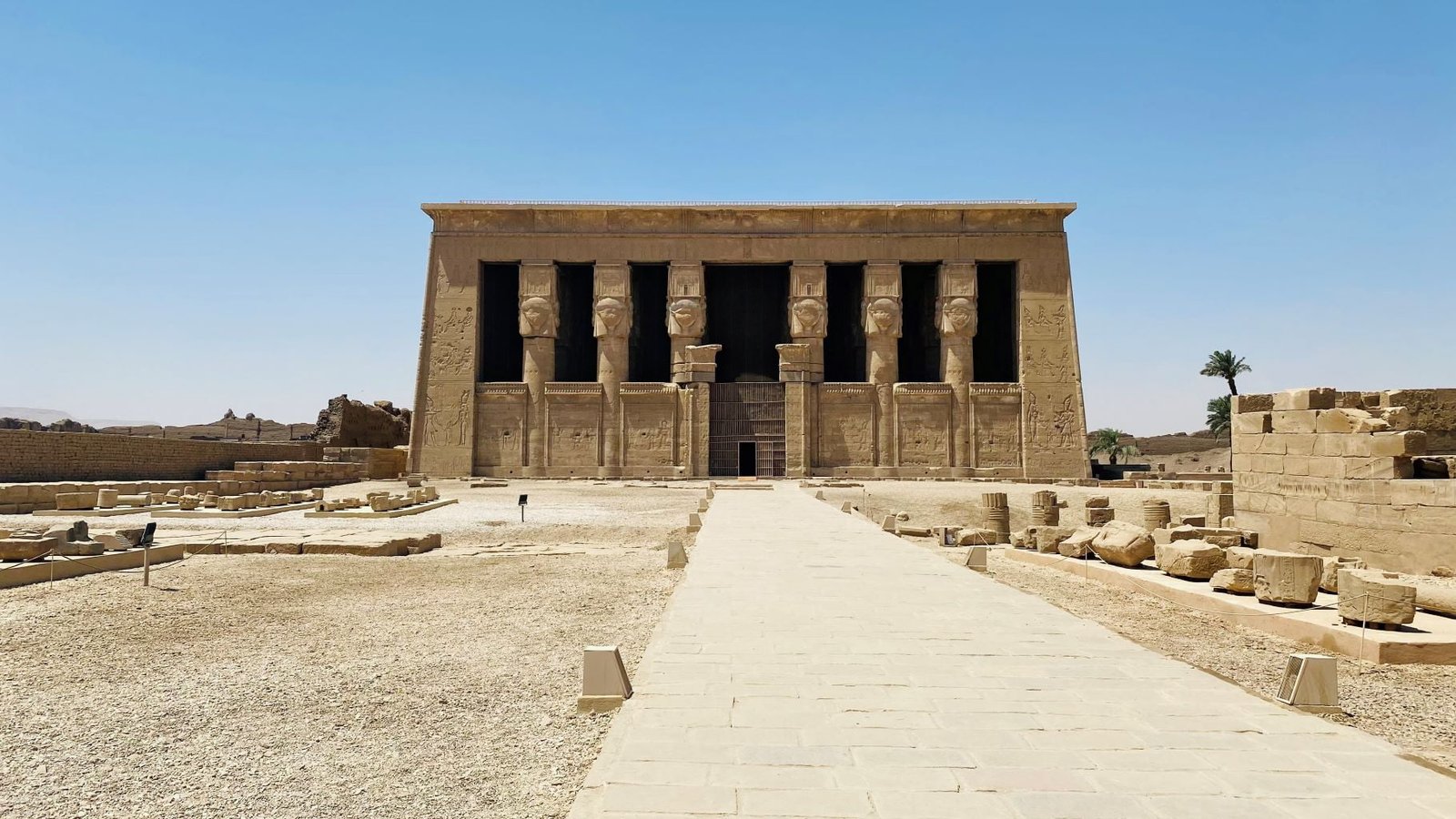
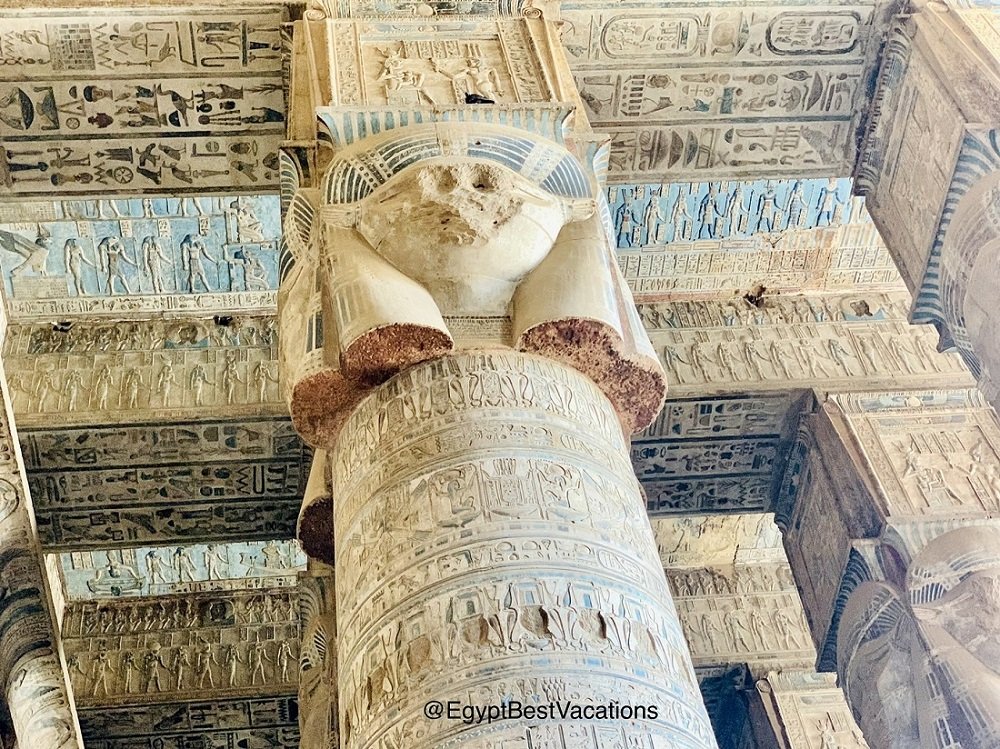
With your Egyptologist you walk the full sequence that an ancient priest would have known. First the Great Hypostyle Hall, with its 24 columns crowned by the four-faced head of Hathor and a ceiling that, since a long conservation project cleaned away two thousand years of soot, glows again in deep blue and ochre with the sky goddess Nut, the hours of the night and the signs of the zodiac. Then the inner halls, the sanctuary where Hathor’s statue once stood, and the side chapels that still carry traces of colour. From there a decorated staircase leads up to the roof, where the Osiris chapels hold the famous round zodiac ceiling. The original was cut out and shipped to France in 1821 and hangs in the Louvre; what you see is a precise cast in its original place, and standing under it is still the only way to understand how it worked.
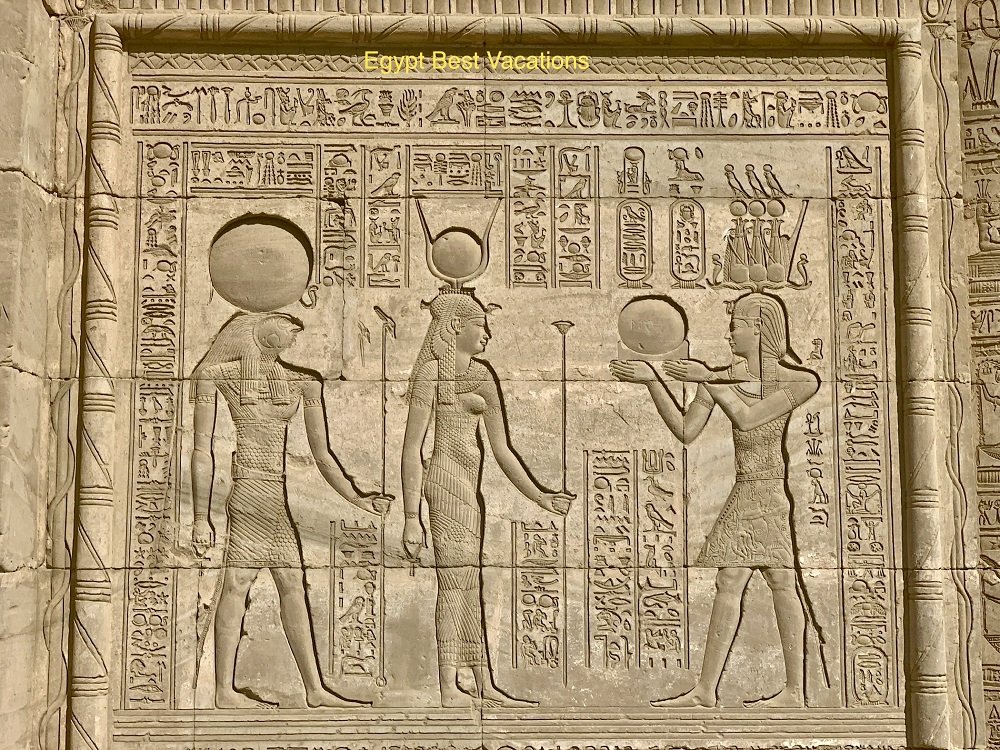
Outside, on the rear wall of the temple, is the relief most visitors come for: Cleopatra VII and her son Caesarion, carved in her lifetime, making offerings to the gods of Dendera. Nearby lie the sacred lake, now a sunken garden of palm trees, the small Temple of Isis, the Roman birth house with its scenes of the divine child, and a fifth-century Coptic basilica built from the temple’s own blocks. Your guide explains what each one meant and why they sit where they do.
The times below are for the standard morning departure. An afternoon departure (pickup around 11:00, back around 17:00) is available on request, but we recommend the morning: the halls are cooler, quieter and the light on the ceiling is better.
07:00 – Pickup in Luxor
Your Egyptologist and driver collect you from your hotel lobby, or from the quay if you are on a Nile cruise ship docked in Luxor. West Bank hotels are picked up first, so your time may be 15 minutes earlier. Bottled water is in the car.
07:00 to 08:45 – The drive north
The route is the highway from Luxor through Tiba to Qena, then across the Nile to Dendera: about 1.5 to 2 hours depending on traffic and checkpoints, with sugarcane fields and villages on either side once you leave the city. Your guide uses the drive to set the scene, so you arrive knowing who Hathor was, why Cleopatra’s family invested in this temple and what to look for on the ceiling. You reach the Dendera car park around 08:45.
08:45 to 09:00 – Through the gate
Tickets are pre-arranged, so you walk straight in. The first stop is the Roman gateway in the mudbrick enclosure wall, then the approach past the Roman birth house and the Coptic basilica. You get your first view of the six Hathor-headed columns of the façade from here.
09:00 to 09:45 – The Great Hypostyle Hall and inner temple
This is the heart of the visit and you will not be rushed. Your guide reads the astronomical ceiling with you, panel by panel, then leads you deeper into the temple: the second hypostyle hall, the offering hall, the sanctuary and the chapels around it. Where the crypts are open, you climb down into the narrow decorated corridors under the floor where the temple’s treasures were kept, including the reliefs that internet folklore calls the “Dendera light” and which your Egyptologist will explain properly.
09:45 to 10:15 – Up to the roof
A gently sloping staircase, decorated with a procession of priests carrying the goddess to the roof for the New Year festival, takes you up to the rooftop chapels. Here is the round zodiac, the open-air kiosk where Hathor’s statue met the rising sun, and a view over the whole enclosure and the fields beyond. You come back down by the second, straight staircase, exactly as the procession did.
10:15 to 10:45 – The outside walls and the rest of the enclosure
Around the back of the temple your guide shows you the giant relief of Cleopatra VII and Caesarion, then the sacred lake, the Temple of Isis, the ruined sanatorium where pilgrims once slept hoping for healing dreams, and the birth house of Nectanebo I, the oldest standing building on the site.
10:45 to 11:00 – Time on your own
Fifteen minutes to go back to whichever hall you want to photograph without commentary, use the facilities, or sit in the shade of the columns.
11:00 to 12:45 – Return to Luxor
The same highway back through Qena and Tiba to Luxor. Your guide is happy to answer questions or leave you to doze. Drop-off at your hotel or ship is between 12:30 and 13:00, in time for a late lunch and a free afternoon, or for an onward flight from Luxor airport after 15:00.
Total time: 5.5 to 6 hours. If you want longer inside the temple, tell us when booking and we will hold the car; the price does not change.
Karnak is bigger and the Valley of the Kings is more famous, but neither shows you what a working Egyptian temple looked like with its roof on. At Dendera the light comes in through the same slits the builders cut, the ceiling colours are original, and you can follow the priests’ route from the front gate up to the roof and back. It is the closest thing Egypt has to walking into an intact temple, and after a morning here the ruined halls of Luxor make much more sense.
The site is also quiet. Dendera is outside the main Luxor circuit and takes some effort to reach, so the crowds that fill Karnak by mid-morning are not here. On most days you will share the Great Hypostyle Hall with a handful of other visitors.
It works well for travellers who have already seen the Luxor highlights and want one more temple that is different, for Nile cruise passengers with a free morning in Luxor, and for anyone with an interest in astronomy, colour or Cleopatra. The site is flat and the walking is easy; the only climb is the staircase to the roof, which is wide and shallow. The crypts are optional and involve a short vertical ladder, so they are not for anyone uncomfortable in tight spaces.
If you would rather see Dendera together with Abydos, the temple of Seti I with the finest relief carving in Egypt, book our Full Day Tour to Dendera Temple and Abydos Temple from Luxor instead. That version runs 10 to 12 hours and includes lunch.